Projects
Undergraduate Researcher (UROP) - MIT CSAIL, Computational Design & Fabrication Group
Sep 2026 - Present
I’m conducting research on neural dynamics modeling for robotics.
Advisors: Prof. Wojciech Matusik and Zhiyang (Frank) Dou
LEAPS: Long-Horizon Event-Aware Prediction for Rigid-Body Simulation
In progress
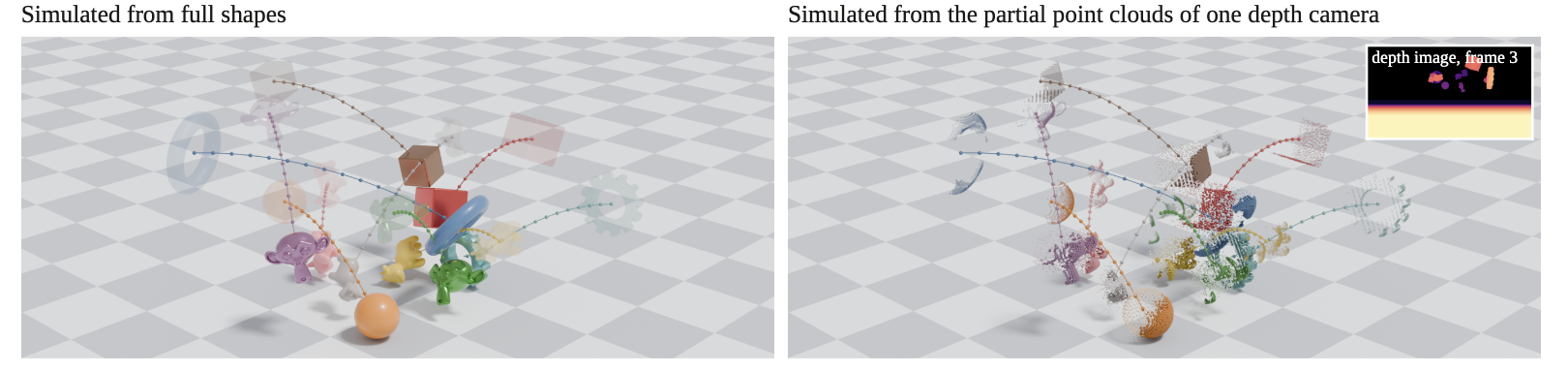
Learned physics simulators that take long time steps usually describe each step with a single acceleration, which breaks down when a step crosses a collision: the motion is smooth on either side of an impact but has a sharp kink at it. LEAPS instead predicts, in one network evaluation, how each object moves over a whole interval of frames, including when contact events happen and how they change its velocity, and then reads out every frame of the interval in closed form. Contact between objects is computed directly from surface point clouds instead of meshes, so the simulator can also run from what a single depth camera sees, as in the right-hand image below.
Robot-Replica: Franka Panda Evaluation Site
In progress
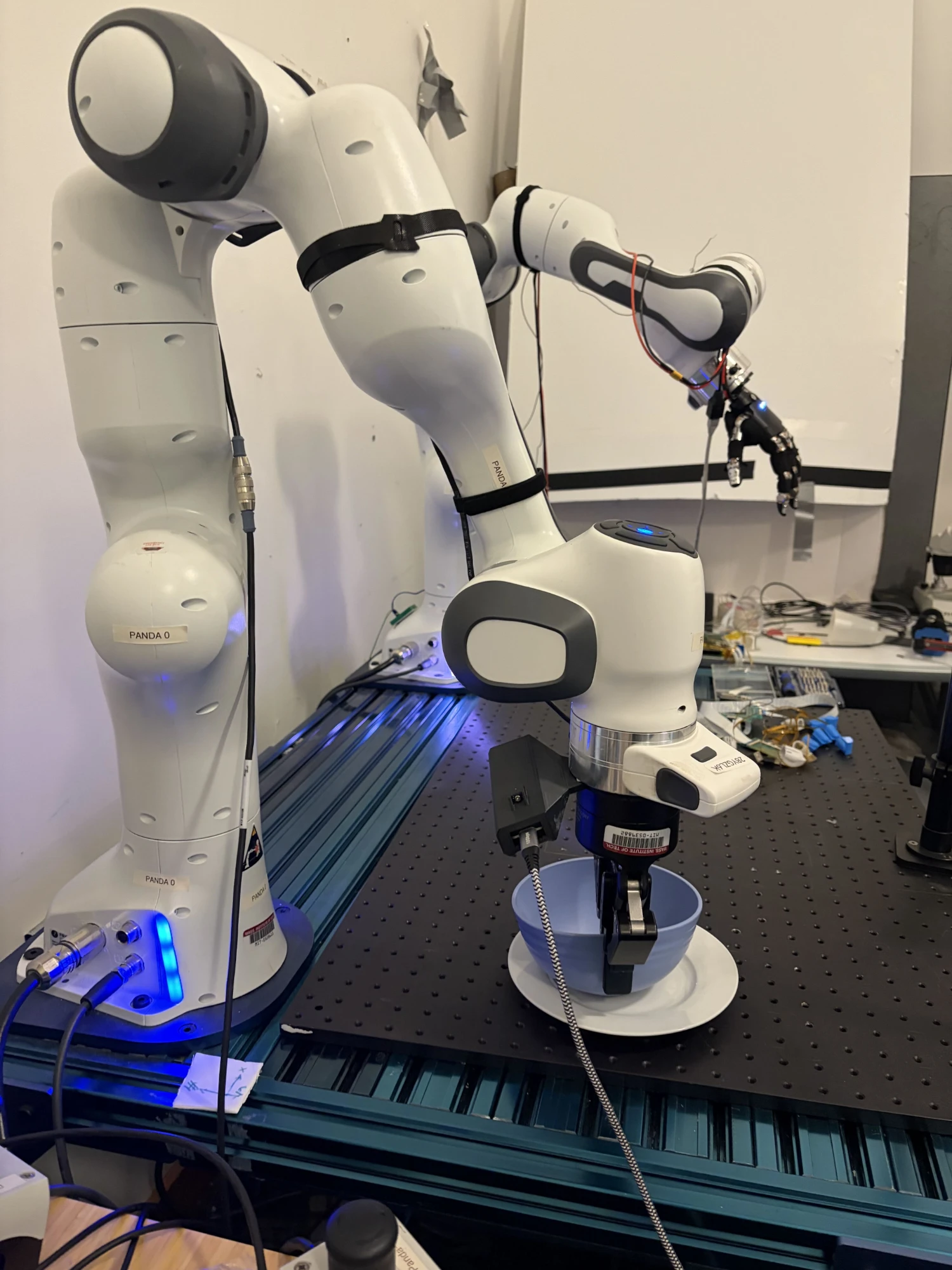
I’m helping build a hosted Franka Panda evaluation site for RobotReplica, adding a new reproducible manipulation benchmark to its network of robot sites. It runs the VLA-Replica benchmark tasks, which were designed for a small SO-101 arm, on a Franka Panda with a Robotiq gripper and three ZED cameras arranged as in DROID, driven by a policy trained on DROID data. The first task is putting a bowl on a coaster. This is a collaboration between the Computational Design and Fabrication Group and the Perceptual Science Group at MIT.
AI Safety Research
SCOPE: Semantic Entropy Probes for LLM-as-a-Judge
LLMs are often used as judges to rate other models' outputs, but the judges hallucinate too. Semantic entropy catches hallucinations by measuring how much the meaning of a model's answers varies across many samples, but that takes many generations per input. SCOPE extends semantic entropy probes to LLM-as-a-Judge rating–rationale tasks: a linear probe trained on the judge's hidden states predicts whether its semantic entropy is high from a single forward pass. Confident judgments are accepted right away, while uncertain ones are escalated to a stronger model or a human, adding almost no extra compute.
AI Debate for AI Control
Can a trusted monitor reliably catch subtle backdoors that an untrusted model slips into its code? Using APPS competitive programming problems, our pipeline has an untrusted model write either an honest solution or a backdoored one, then compares plain trusted monitoring with debate-based protocols, including an untrusted consultant, double consultancy and a prosecutor-versus-defense setup, by how well a judge's suspiciousness scores separate the two.
Math Research
On the set of atoms and strong atoms in additive monoids of cyclic semidomains
Let $M$ be a cancellative and commutative monoid. A non-invertible element of $M$ is called an atom (or irreducible element) if it cannot be factored into two non-invertible elements, while an atom $a$ of $M$ is called strong if $a^n$ has a unique factorization in $M$ for every $n \in \mathbb{N}$. The monoid $M$ is atomic if every non-invertible element factors into finitely many atoms (repetitions allowed). For an algebraic number $\alpha$, we let $M_\alpha$ denote the additive monoid of the subsemiring $\mathbb{N}_0[\alpha]$ of $\mathbb{C}$. The atomic structure of $M_\alpha$ reflects intricate interactions between algebraic number theory and additive semigroup theory. For $m, n \in \mathbb{N}_0 \cup \{ \infty \}$ (with $m \le n$), the pair $(m,n)$ is called realizable if there exists an algebraic number $\alpha \in \mathbb{C}$ such that $M_\alpha$ has $m$ strong atoms and $n$ atoms. Our primary goal is to identify classes of realizable pairs with the long-term goal of providing a complete description of the full set of realizable pairs.
Factorizations in rational monogenic semidomains
For $\alpha \in \mathbb{C}$, the monogenic semidomain generated by $\alpha$ is the smallest subsemiring $S_\alpha$ of the complex field $\mathbb{C}$ containing $\alpha$. We initiate a systematic study of the arithmetic and factorizations of the monogenic semidomains $S_q$ generated by rational parameters $q$. After some preliminaries, we introduce and investigate the monoid of technical fractions $T_q$, which is a divisor-closed submonoid of the multiplicative monoid of $S_q$ that encodes a significant amount of arithmetic information about $S_q$. We then study several fundamental factorization properties of $S_q$: the bounded factorization (BF) and finite factorization (FF) properties, the unique factorization (UF) property, and the half-factorial (HF) property. First, we prove that $S_q$ satisfies the UF property if and only if it satisfies the HF property, which happens when $q \in \mathbb{N} \cup \mathbb{N}^{-1}$. We determine all the positive rational values of the parameter $q$ for which $S_q$ satisfies the FF property. Then we show that, over the class of rational monogenic semidomains, the BF property is equivalent to the ascending chain condition on principal ideals. Finally, we prove that $S_q$ is a Krull semidomain if and only if it is root-closed, which happens precisely when $S_q$ satisfies the UF property.